
When a Jury Found the U.S. Government Guilty in the Assassination of Martin Luther King Jr.
- J Marzo

- Jul 23, 2025
- 6 min read
By Muckraker 21
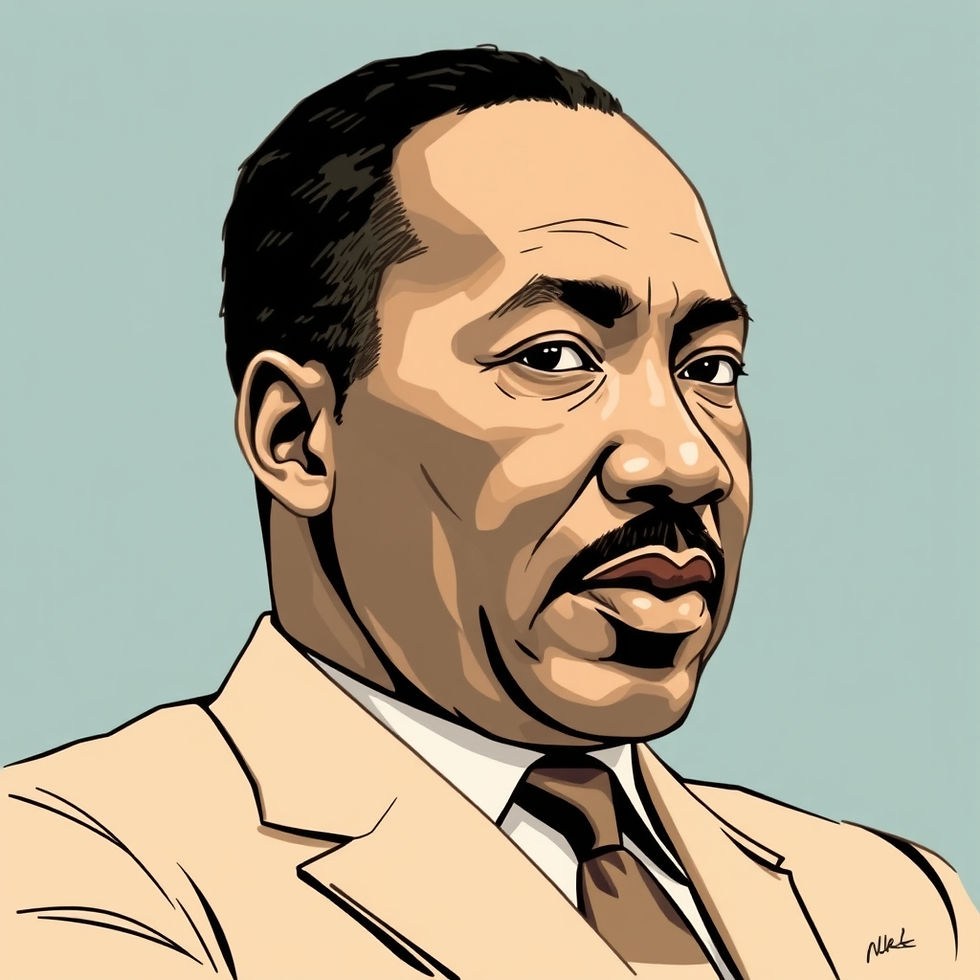
It happened in the same city, just a few miles from the site of the crime.
Thirty-one years after a rifle bullet struck Dr. Martin Luther King Jr. on the second-floor balcony of the Lorraine Motel in Memphis, Tennessee, a courtroom full of jurors sat in silence, listening to testimony that challenged everything the public had been told about his death.
There were no TV crews parked outside. No breaking news alerts. No front-page stories.
But the conclusion was historic: A twelve-person jury unanimously found that Dr. King had been murdered as the result of a conspiracy, and that government agencies had been involved.
And yet, to this day, almost no one knows it happened.
A Lingering Doubt That Turned Into a Quest
Ever since April 4, 1968, the King family had questioned the story handed to them by authorities: that James Earl Ray—a two-bit petty criminal and fugitive—had acted alone in killing one of the most heavily surveilled, threatened, and celebrated figures in the country.
Ray was arrested weeks after the assassination at London’s Heathrow Airport. He pleaded guilty in 1969, then immediately recanted. He would spend the rest of his life proclaiming his innocence and begging for a trial he would never receive.
In the 1990s, Coretta Scott King and her children began to speak more openly about their belief that the truth had been buried. They weren’t conspiracy theorists—they were the family of the man whose life had been taken, and they had seen firsthand how the story kept changing.
They turned to William Pepper, a journalist and attorney who had first met King in the last years of his life, during his public campaign against the Vietnam War. Pepper became convinced that King was not only killed by a sniper, but by an alliance of people who felt threatened by his message and momentum. He compiled decades of interviews, government documents, and witness statements. The pattern was there. The evidence had been ignored.
Pepper, alongside the King family, made a decision: if the U.S. criminal justice system wouldn’t retry James Earl Ray—or even allow a hearing—then they would take their case to civil court, in a lawsuit against a man who had finally admitted involvement in the killing.
The Bar Owner Who Broke His Silence
His name was Loyd Jowers, and in 1968 he had owned Jim’s Grill, a small restaurant just behind the Lorraine Motel. For decades he kept quiet.
Then, in 1993, on national television, he said it: he had been part of a plot to kill Martin Luther King Jr.
In an interview on ABC’s Prime Time Live, Jowers claimed he had received $100,000 from a Memphis businessman with ties to the Mafia and had been asked to facilitate the assassination. He said the shot had not come from the rooming house bathroom, where Ray was supposedly hiding, but from the brush behind his restaurant—just yards from where King stood.
He said he took possession of the murder weapon after the shot was fired and passed it off to another conspirator. James Earl Ray, he claimed, had no idea what was really going on. He was being handled by a man named “Raoul”—a mysterious figure never fully identified.
With Jowers’ confession and Pepper’s years of evidence, the King family filed King v. Jowers et al., not for revenge, but for closure.
A Trial Without Cameras—But Not Without Drama
The trial opened in late 1999 in Memphis’s Shelby County Circuit Court. It would last four weeks. More than 70 witnesses testified, and the courtroom quickly transformed into something more powerful than any government investigation ever allowed: a wide-ranging, open forum on the unanswered questions surrounding King's death.
And what emerged was chilling.
A Carefully Constructed Trap
One of the most damning themes of the testimony was how King’s protection was quietly stripped away in the hours before his death.
Two Black detectives who had been part of his security detail were reassigned. Black firefighters stationed at the nearby firehouse were transferred. The usual visible police presence—standard for a figure like King—was gone. Instead, King was left exposed on the Lorraine Motel’s second-story balcony, at the exact hour his daily routine made him predictable.
Former Memphis police officers admitted under oath that these assignments were changed without explanation. When asked who had given the orders, names and departments blurred. But one stood out: Frank Holloman, then-director of the Memphis Police and Fire Departments, who had previously spent 25 years working for the FBI.
The Witnesses No One Wanted to Hear
The jury heard from numerous eyewitnesses who recalled seeing or hearing something far different from the official story.
Earl Caldwell, a journalist with The New York Times, testified that he was at the motel and heard the shot come from behind the building, not across the street. He wasn't alone. Others described seeing a man in the thick bushes behind Jim’s Grill with what appeared to be a rifle.
Even more suspicious: those bushes were cut down the very next morning by city workers, destroying any chance for forensic examination.
This wasn’t a random act of maintenance. The area was known to be part of the investigation. And now it was gone.
The FBI's Secret War Against King
Then came the FBI files.
Former agents and experts outlined a disturbing portrait of COINTELPRO, the covert counterintelligence program that had targeted civil rights leaders throughout the 1960s. Dr. King was a primary focus. He had been wiretapped, followed, recorded, and psychologically attacked by the very agency now claiming to investigate his death.
The jury saw the infamous anonymous letter sent to King in 1964, which included a recording from an FBI surveillance operation and urged him to commit suicide. The letter threatened public exposure and disgrace. It was a coordinated effort to break him down and destroy his public image.
One witness claimed that the FBI, by 1968, viewed King not as a civil rights activist, but as a revolutionary—especially after he connected racism, capitalism, and militarism in one sweeping critique of American policy.
A Military Unit in the Shadows
Perhaps most unnerving was the testimony involving the U.S. military.
The jury heard that Dr. King was under active surveillance by the 111th Military Intelligence Group, a unit tasked with monitoring potential threats to national security. Several members of this unit had been tracking King in Memphis.
But on the day of the assassination, they were ordered to stand down.
Why? No answer was ever provided.
One witness discussed Operation Lantern Spike, a top-secret initiative aimed at containing domestic unrest. It was allegedly used to track civil rights figures and could, in theory, authorize covert actions against them.
Though no document in court explicitly linked Lantern Spike to King’s assassination, its existence—and the role of military intelligence in Memphis—added yet another layer to the conspiracy.
Loyd Jowers' Final Story
Jowers’ own testimony was presented via video. In it, he calmly described how he had received the murder weapon from a man named Raoul, then handed it off to someone else. He said the shooter was not James Earl Ray but a hired gun, hidden in the bushes, coordinated with police and organized crime figures.
Jowers had changed details of his story over the years. But when taken alongside the other testimony—the withdrawals of protection, the alternate eyewitness accounts, the FBI’s war on King—his narrative no longer stood alone.
It became the final puzzle piece in a picture the government never wanted seen.
A Verdict With No Spotlight
On December 8, 1999, the jury deliberated briefly and returned a verdict.
They found that Loyd Jowers and others, including government agencies, were part of a conspiracy to assassinate Dr. Martin Luther King Jr.
The courtroom was stunned. The King family wept. William Pepper, after decades of research, had brought the truth to light.
But outside the courthouse?
Silence.
The Story That Vanished Overnight
Despite its historic implications, the trial was ignored by almost every major media outlet. There were no retrospectives. No interviews with jurors. No calls for a new investigation. A trial that should have sparked a national reckoning instead faded from memory before it even entered public consciousness.
Coretta Scott King addressed the verdict with grace but unmistakable clarity:
“This verdict is not only a great victory for my family, but also a great victory for America. It is a great victory for truth itself… The jury was clearly convinced by the extensive evidence that was presented during the trial that… the assassination was the result of a conspiracy.”
The Truth That Refuses to Die
This was not a fringe lawsuit. This was a legal case in an American courtroom, brought by the family of a Nobel Peace Prize winner, backed by sworn testimony and corroborated evidence.
And yet, it has been buried—perhaps because the truth it exposes is too dangerous, too uncomfortable, or too disruptive.
Dr. King had grown into more than a civil rights leader. By 1968, he was a moral voice challenging war, poverty, capitalism, and systemic oppression. He was connecting the struggles of Black Americans to global injustice and calling for nothing less than a revolution of values.
And when a man with that kind of vision gathers that kind of momentum, history has shown us what happens.
Sources:
Trial transcript: King v. Jowers et al., Shelby County Circuit Court, 1999
“Complete Transcript of the King Family Trial,” The King Center
NPR: “Jury Rules in King’s Death”
An Act of State: The Execution of Martin Luther King by William F. Pepper
ABC News, Prime Time Live, interview with Loyd Jowers (1993)
U.S. House Select Committee on Assassinations Final Report (1979)
FBI COINTELPRO Files, released under FOIA


